



A few months ago, I found myself staring at hundreds of pages of technical documents.
There were frameworks. Playbooks. Guidance notes. Financial models. Toolkits.
All excellent resources. All important. And yet, I kept wondering:
How many people would really remember them?
The question emerged while working on a global learning programme about landscape finance, a topic that sits at the crossroads of conservation, agriculture, climate, governance and finance. The challenge was not a lack of knowledge. Quite the opposite. The challenge was how to make that knowledge meaningful and usable for professionals around the world.
As learning designers, facilitators and consultants, we often assume that if we explain something clearly enough, people will understand it.
But understanding is not the same as remembering.
And remembering is not the same as changing behaviour.
So, how do we achieve a positive outcome when dealing with complex knowledge that needs to be unpacked?
A failed mangrove project
One moment from the learning toolkit has stayed with me while reading all those technical documents.
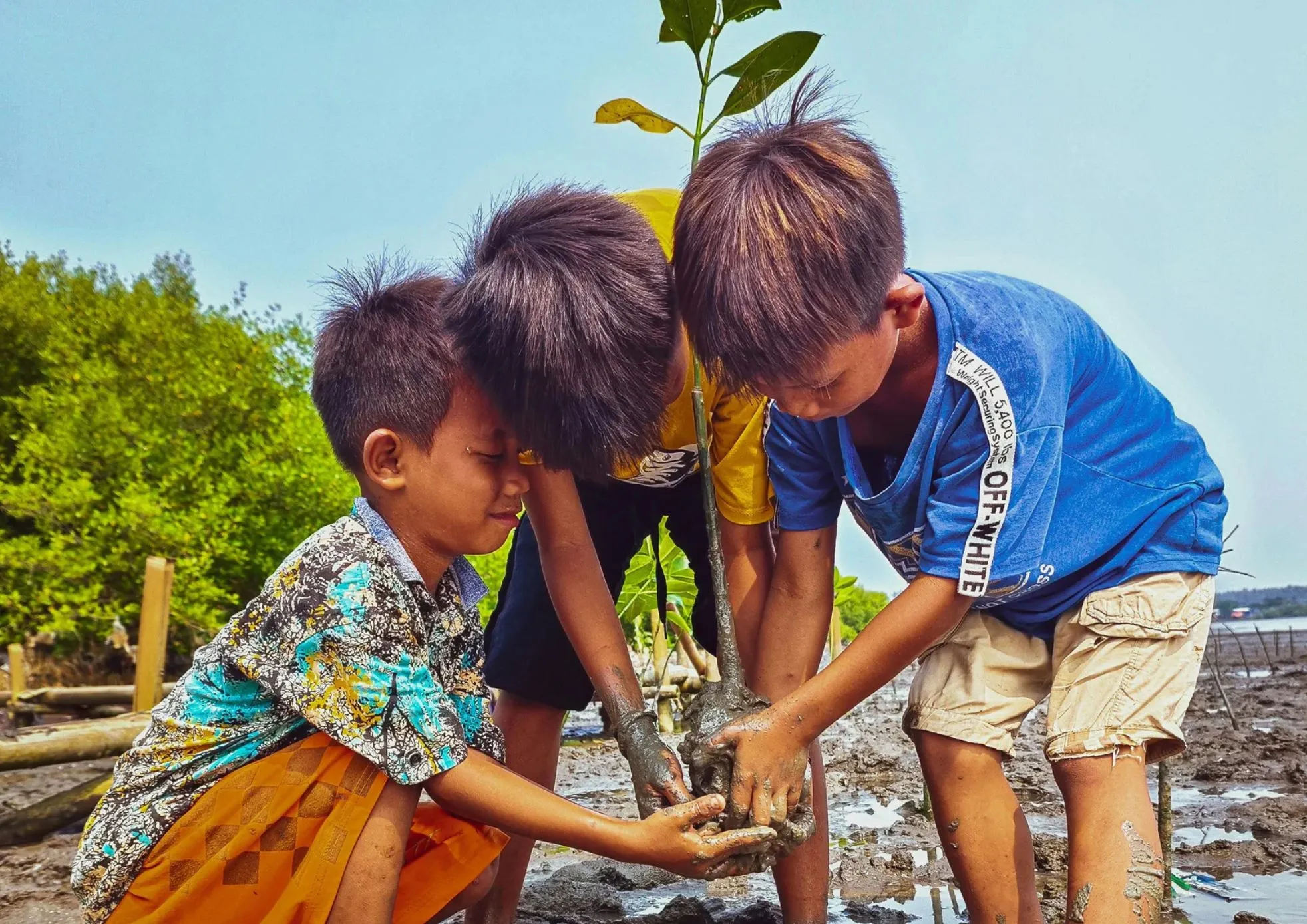
Learners are introduced to a seemingly straightforward conservation project: A financial institution invests in mangrove restoration.Trees are planted. Funding is secured. Experts are involved. Everything appears to be in place.
And then the project fails.
Within a year, villagers begin cutting the mangroves again.
What went wrong?
The answer was not poor technical design.
The answer was that nobody had fully understood the broadersystem. The project addressed the visible problem, the disappearing mangroves, but not the deeper drivers behind it: poverty, limited livelihood opportunities, competing priorities and the realities faced by local communities.
To create our learning trajectory, we could have shown learners a diagram about systems thinking.
Instead, we told a story.
And that story accomplished something a framework alone rarely can: it made people care.
Suddenly learners understood that the problem was never just about trees.
It was about people.

Stories are how people make sense of complexity
Throughout the programme, one message appears again and again: landscapes are systems. People, nature, food production, livelihoods and finance continuously influence one another.
That sentence is technically correct. But stories bring it to life.
Stories help us understand why a farmer may choose immediate income over long-term sustainability. Stories help us understand why communities sometimes resist conservation initiatives. Stories help us see that financial decisions made in a distant office can influence what happens in forests, farms and fisheries thousands of kilometres away.
A good story allows us to walk for a moment in somebodyelse's shoes. And once we do that, we begin to understand complexity differently.
One misconception about storytelling is that it simplifies complex subjects. My experience is exactly the opposite. The more complex the topic, the more important storytelling becomes.
In the learning programme, learners meet guide characters and follow a recurring case study from Madagascar. Rather than receiving abstract definitions, they encounter decisions, trade-offs and dilemmas. They discover how finance can either support or undermine nature and livelihoods.
The technical concepts remain. But they become human. And that changes everything. People rarely remember a framework. They remember a conversation. A dilemma. A character. A moment of realisation.
What surprised me most is how much I learned myself.
Throughout the project, I spent months reading about agriculture, food systems, biodiversity loss and conservation. Again and again, I encountered the same reality: our current food systems are placing enormous pressure on nature. Agriculture shapes landscapes, drives land-use decisions and influences the future of forests, water, biodiversity and livelihoods.
At first, these were just facts.
Then they became stories.
Stories about forests converted into farmland. Stories about communities struggling to make a living. Stories about the difficult choices people make when short-term survival conflicts with long-term sustainability.
But there was also hope.
One message repeatedly appeared throughout the programme: agriculture can be part of the solution.
The concept of nature-positive agriculture is simple. Produce food while protecting, restoring and enhancing nature. Healthy soils, biodiversity, clean water and resilient ecosystems are not obstacles to food production. They are what make food production possible in the first place.
And perhaps that is where storytelling matters most.
We already have many of the solutions. What we often lack are the stories that help people understand them, believe in them and see themselves as part of them.
So yes, this project taught me a lot about sustainable finance, conservation and food systems.
But perhaps the biggest lesson was this: the future of nature and the future of food are not separate stories.
A small challenge
The next time you sit down for a meal, take a moment to think about the landscape behind it.
Where did the food come from? What happened to the soil, the water, the biodiversity and the people involved in producing it?
Food is never just food.
Behind every plate lies a story about nature, livelihoods, choices and trade-offs.
The more we understand those stories, the better equipped we are to create food systems that work for both people and planet.
And perhaps that is where real change begins.
And if you are curious about the learning journey that inspired these reflections, explore the Landscape Finance Hub (landscapefinancehub.org), built with our partner InnovaHub for WWF.


