


%20Medium.webp)

(Almost) Every project has a theory of change. And every project has a monitoring plan. But in our experience, these two things are often designed separately, by different people, at different moments — and then they never quite find each other again.
The result is a monitoring system that measures activity but cannot explain change. Teams know what they did. They do not know why it worked, or whether it is working at all.
This is one of the most common problems we see in the field. And it is almost never a capacity problem. It is a design problem.
Don't put your Theory of Change in the drawer
A theory of change is a planning tool. It maps how your intervention is supposed to lead to the desired change: what you do, what that produces, what changes as a result, and why (you can learn more about Theory of Change here and download our e-book). It makes your underlying assumptions explicit and visible — which is exactly why it is useful.
But many organisations treat it as a compliance document. They write it for the proposal, present it to the donor, and then put it away. By the time the monitoring plan is designed, the theory of change is already in a drawer.
Missing the link
The practical question to ask at the design stage is: for each step in our theory of change, what evidence would tell us whether it is working? These need to be included in a monitoring plan. Also, a Theory is based on assumptions. Information about assumptions will tell us why change is taking place as foreseen, or not? Include them in your monitoring plan!
Analysis of the data/evidence and information about assumptions should provide us feedback on our theory. Was our thinking correct, or not? Do we need to adjust our theory? That is what we call the missing link. We don't learn enough. We don't adapt our Theory!
What to do differently
Bring the theory of change into the monitoring design process. Not as a reference document — as the starting point. Ask the team: what are we assuming here, and how would we know if we were wrong?
Then design monitoring to answer that question. Not to develop a results framework with corresponding indicators. Not to satisfy a reporting requirement. To learn something, you really need to know about your theory.
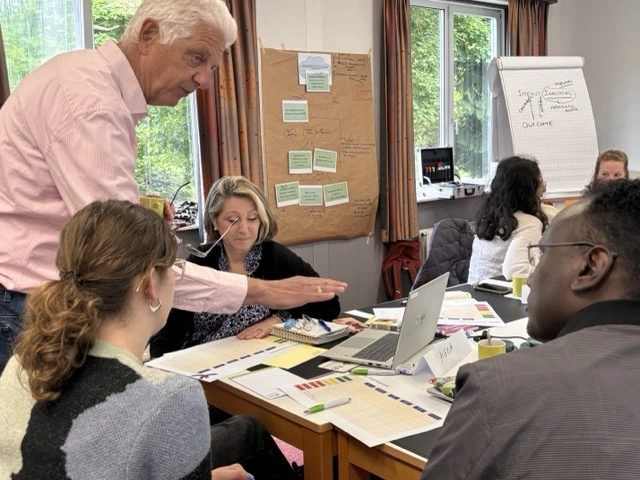
When these two things are aligned — when the Theory of Change and the monitoring plan speak the same language — teams make better decisions, adapt faster, and produce evidence that is useful.
That is what good planning looks like. Not a perfect document. A system that helps you think.
Sam Boering is a trainer and consultant at MDF Training & Consultancy, with extensive experience in planning, monitoring, evaluation, and learning across complex international programmes. He leads the Essentials for Effective PMEL course.


