


%20(2).webp)

How do you prepare and implement good projects? What are helpful planning, monitoring, evaluation and learning (PMEL) tools? That was the challenge at the heart of four intensive training sessions that brought development professionals from across Pakistan together in Islamabad earlier this year.
The training was organised by MDF and Helvetas Pakistan, together with the Pakistan Poverty Alleviation Fund (PPAF). Over two weeks, 120 participants took part in two parallel groups, each completing five days of hands-on work in project cycle management, from project design and stakeholder analysis to monitoring, evaluation, understanding change processes (better!).
The size of the training event was significant. Yet, the more important question is what those 120 professionals will do differently now.

Chasing the right results = change that matters
Much of development work gets stuck at the level of outputs. Workshops held. Reports submitted. Boxes ticked. What is harder, and what this training set out to address, is the thinking behind the work: who are the people a project is trying to reach, what needs to change to make their lives better, and what does it take to bring about that change, change that matters?
The Social Change Matrix, one of the tools we used, focuses on that question. It pushes organisations beyond the usual solutions by mapping what really needs to change in a structured way: shifts in personal as well as institutional behaviour, in relationships, in access to and participation in decision taking structures, in societal norms and values, etc.
Stakeholder Analysis 2.0 works in a similar fashion. Most project managers know how to list the actors (individuals and organisations) affected by their work. Few have the tools to understand the behaviour of actors (what and why they do what they do), as this behaviour is shaped by: (hidden) interests, their relationships with other actors, and the presence or absence of power in these relations. The Stakeholder Analysis tool used in Islamabad helps teams build a more honest picture of the stakeholder landscape of their project and supports decision taking as to how to deal with stakeholders in an appropriate manner.
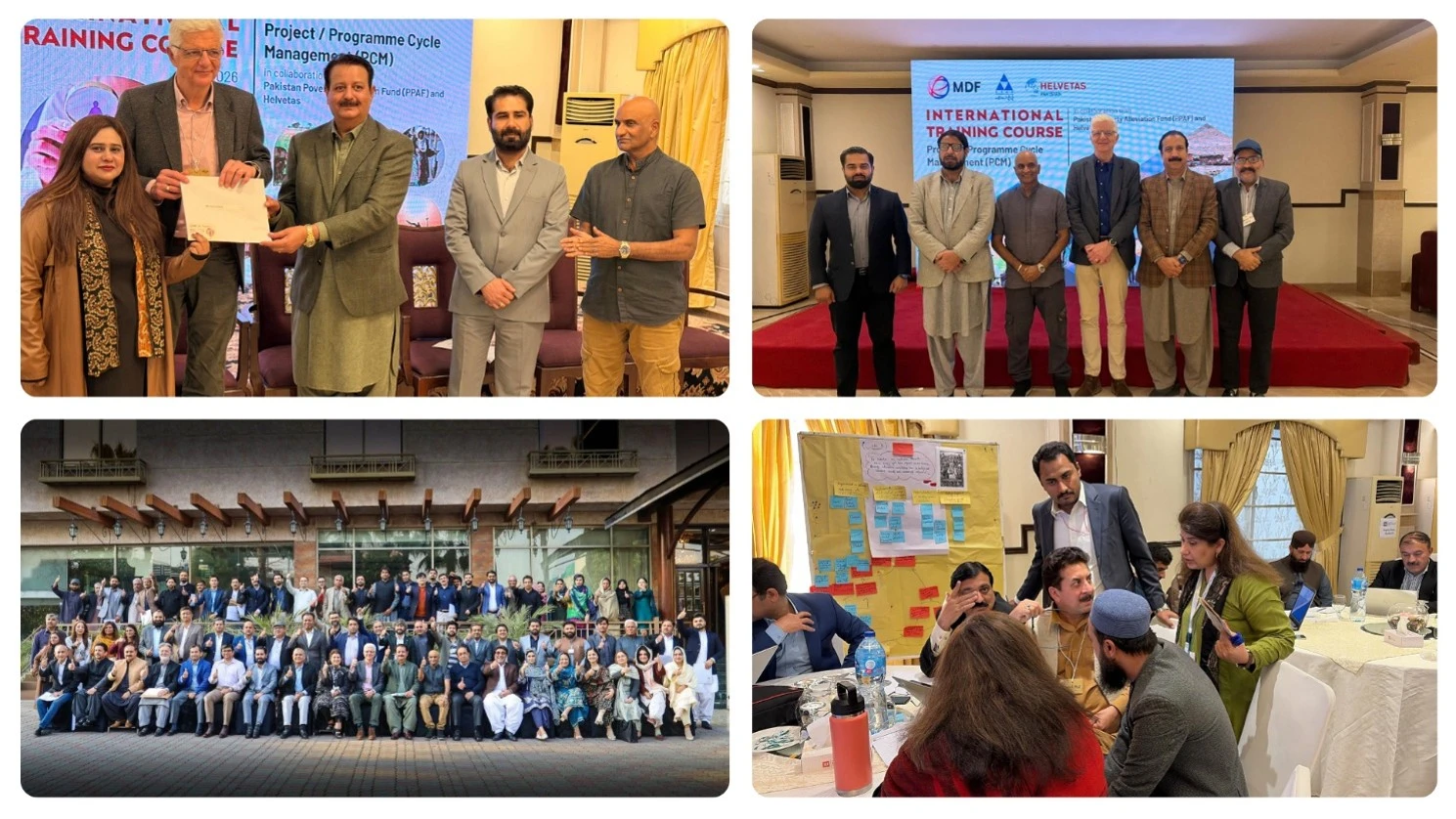
Then there was the question of data. Many of the organisations represented in the room collect information from communities through surveys, interviews, and field visits. What they often lack is a clear path from that raw information to analysis, that shapes decisions. The sessions on qualitative data methods focused on closing that gap: not just how to gather data, but also how to make sense of the gathered data, and how to communicate it usefully (for example in reports).
Integrating new tools in learning (padlet and AI)
The training made use of tools that were new to most participants. While not forgetting the MDF training style (adult learning approach with lots of group work), all group work was shared real time on Padlet and discussed together, making use of a large screen for all participants in the room to see. In one session, participants used AI tools to develop visual representations of their theories of change. It was one of the most engaging moments of the programme: people encountering a new way to make abstract thinking concrete and sharing it with peers.

The 120 professionals who completed the programme work across Pakistan, in organisations that design and deliver projects reaching some of the country's most underserved communities. The direct impact of a training is always hard to measure. What is clearer is the logic: when project teams ask better questions at the design stage, monitor more honestly, and understand the communities they serve more deeply, the projects that follow are more likely to do and achieve results = change that matters.
That is the work PPAF is investing in, and it is why training like this, rigorous, practical, and grounded in real impact, matters beyond the room it takes place in.


